
High School Grade Level Names: Freshman, Sophomore, Junior & Senior Complete Guid
Introduction
If you have ever wondered what high school students are called at each grade level, you are not alone. The American school system uses unique names — freshman, sophomore, junior, and senior — that confuse students, parents, and international visitors alike. These high school grade level names carry real meaning and come with their own academic expectations, social traditions, and milestones. Understanding each grade name helps students know what to expect and helps parents support their children at every stage. This complete guide covers everything you need to know about HS grade level names, from elementary through high school and beyond.
Table of Contents
- What Are High School Grade Levels? — Quick Answer
- What Grade Is a Freshman?
- What Grade Is a Sophomore?
- What Grade Is a Junior?
- What Grade Is a Senior?
- What Grade Is Prom?
- What Is Grade School? (Elementary & Middle School Explained)
- What Grade Is Algebra 1 and Algebra 2?
- Grade Level Books — Reading Level Guide by Grade
- DIBELS and STAR Math Scores by Grade Level
- Is There a 13th Grade? Everything You Need to Know
- How to Skip a Grade — Is It Possible?
- What Is a Good Grade in High School?
- Frequently Asked Questions
What Are High School Grade Levels? — Quick Answer {#quick-answer}
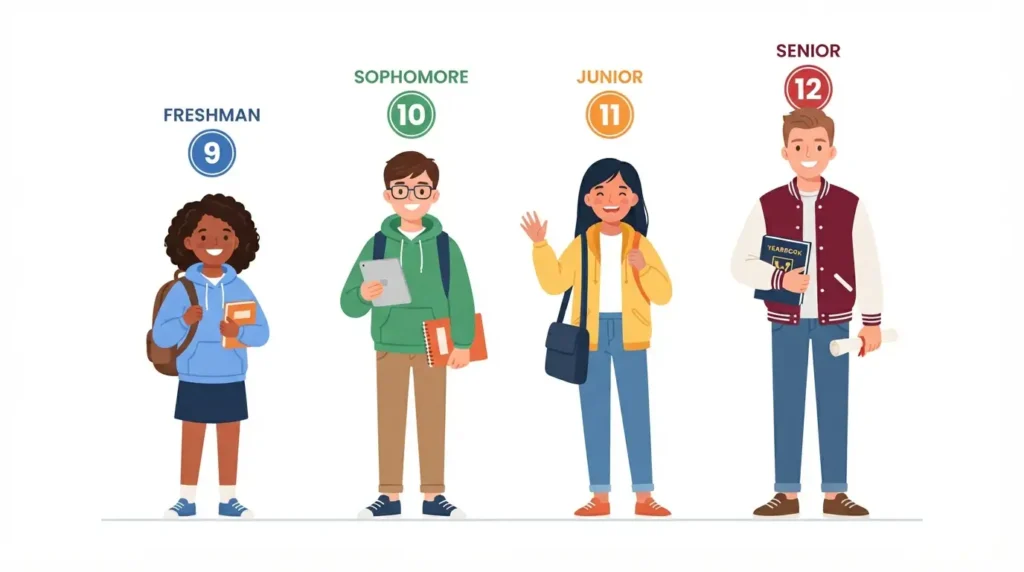
High school in the United States spans four years, covering grades 9 through 12. Each grade has both a number and a traditional name that American students use every day. These high school grade level names — freshman, sophomore, junior, and senior — are also used in college to describe the four years of undergraduate study. Below is the complete grade level chart from kindergarten through 12th grade to give you the full picture. Understanding the entire K-12 system helps students and parents plan ahead for academic and career goals.
| Grade | Name | Typical Age |
|---|---|---|
| K | Kindergarten | 5–6 |
| 1st | First Grade | 6–7 |
| 2nd | Second Grade | 7–8 |
| 3rd | Third Grade | 8–9 |
| 4th | Fourth Grade | 9–10 |
| 5th | Fifth Grade | 10–11 |
| 6th | Sixth Grade | 11–12 |
| 7th | Seventh Grade | 12–13 |
| 8th | Eighth Grade | 13–14 |
| 9th | Freshman | 14–15 |
| 10th | Sophomore | 15–16 |
| 11th | Junior | 16–17 |
| 12th | Senior | 17–18 |
The four high school grade names are the most commonly searched and most frequently misunderstood part of the American education system. Students who transfer from other countries often find these names confusing at first. Once you learn them in order — freshman, sophomore, junior, senior — they become second nature. This guide breaks down each one in detail so there is never any confusion.
What Grade Is a Freshman? {#freshman}
A freshman is a student in 9th grade, which is the first year of high school. Most freshmen are between 14 and 15 years old when they enter high school for the first time. The word “freshman” dates back to the mid-16th century and originally meant “newcomer” or “novice.” It has been used in the American academic system since the early 20th century to refer to first-year students. In college, a freshman is also a first-year student, making the term consistent across both high school and higher education.
Freshman year is often considered the most significant because it sets the academic tone for the next four years. Students entering 9th grade must adapt to a new school environment, more rigorous coursework, and greater independence. This is also the year when a student’s GPA starts being recorded on the official high school transcript. Many colleges review freshman year grades carefully, so it is important to start strong. Developing strong study habits and getting involved in extracurricular activities during freshman year pays off significantly later on.
💡 Freshman Tip: Your 9th-grade GPA counts toward your cumulative high school GPA, which colleges review. Starting strong in freshman year gives you the best long-term academic foundation.

What Grade Is a Sophomore? {#sophomore}
A sophomore is a 10th-grade student in their second year of high school. Sophomores are typically 15 to 16 years old, and this year is often when students begin to feel more comfortable in the high school environment. The word “sophomore” has a fascinating origin — it comes from two ancient Greek words: “sophos” meaning “wise” and “moros” meaning “foolish,” combining into the playful phrase “wise fool.” The term was first recorded in academic use around the 1650s to describe second-year university students. Today, it remains standard in American schools, while in the UK and other countries, students simply say “second year.”
Sophomore year is when students begin to take more ownership of their academic path. This is commonly the year when students pursue leadership roles in clubs, sports teams, and school government. Many schools also offer the PSAT during sophomore year as an early practice run for college entrance exams. Sophomore year is sometimes called the “planning year” because students start thinking seriously about future goals. Building a strong GPA during this year keeps options open for junior and senior year opportunities.
What Grade Is a Junior? {#junior}
A junior is a student in 11th grade, the third year of high school. Most juniors are between 16 and 17 years old, and this year is widely considered the most academically demanding of the four high school years. The word “junior” traces back to the 13th century, where it was used to describe someone younger than another person of the same name. In the academic context, junior became widely associated with the third year of study in American schools and colleges during the 20th century. Juniors are considered upperclassmen, a distinction that comes with greater respect and responsibility on campus.
Junior year in high school is critical for college-bound students because it is when most standardized testing takes place. The SAT and ACT are typically taken during 11th grade, and many scholarship opportunities open up for students at this grade level. Juniors also begin building their college lists and visiting campuses. Advanced Placement (AP) and dual enrollment courses taken during junior year can earn college credit before graduation. A strong junior year can significantly strengthen a college application and open doors to merit scholarships.
💡 Junior Year Checklist:
- Take the SAT or ACT (or both)
- Begin building your college list
- Request letters of recommendation early
- Start drafting your personal statement
- Research scholarship opportunities
What Grade Is a Senior? {#senior}
A senior is a 12th-grade student in their final year of high school. Seniors are typically 17 to 18 years old, and this grade is the most anticipated and emotionally significant of all four high school years. The word “senior” has been used in the English language since the mid-14th century to describe an older or more experienced person. Its academic use to describe fourth-year students became standardized in American schools during the 17th century. Senior year is the culmination of twelve years of education and marks the transition into adulthood.
Senior year comes with a mix of excitement and high-stakes decisions. College applications, final transcripts, senior portraits, graduation planning, and farewell traditions all define this year. Many seniors also experience what is commonly called “senioritis” — a noticeable drop in motivation after college acceptance letters arrive. Despite the temptation to coast, it is important to maintain grades because colleges can and do rescind admission offers if senior grades drop significantly. Finishing strong in senior year ensures a smooth transition into college or the workforce.

What Grade Is Prom? {#prom}
Prom is traditionally associated with junior (11th grade) and senior (12th grade) students. Most high schools hold two prom events — a junior prom and a senior prom — though some schools combine them into a single event. Senior prom is typically considered the more prestigious of the two, as it marks the final major social event before graduation. Juniors often attend senior prom as guests or dates of seniors, depending on the school’s policy. Some schools allow sophomores and freshmen to attend if they are invited by an upperclassman, but this varies widely by school district.
The tradition of prom in America dates back to the late 19th century, when it began as a simple class banquet at colleges. Over the decades, prom evolved into an elaborate high school tradition involving formal attire, rented venues, limousines, and elaborate preparations. Prom night is a milestone that many students look forward to throughout their high school years. Planning for prom — including attire, tickets, and transportation — often begins months in advance. Whether you attend junior or senior prom, the experience remains one of the most memorable events of the high school grade level journey.
What Is Grade School? (Elementary & Middle School Explained) {#grade-school}
Grade school is a general term that refers to elementary school, typically covering kindergarten through 5th or 6th grade. The grade school meaning can vary slightly depending on the school district, but most commonly it describes the years before middle school begins. In everyday conversation, people often use “grade school” and “elementary school” interchangeably. Understanding the grade school meaning helps parents and students know which level of education is being referenced. The full K-12 school system is divided into three main stages: grade school, middle school, and high school.
Middle school typically covers grades 6 through 8, with students ranging in age from 11 to 14. Some districts use the term “junior high” instead of middle school, and junior high schools often cover grades 7 through 9 in older school configurations. The shift from grade school to middle school is one of the biggest academic and social transitions a child will experience. Class schedules become more complex, students change rooms for each subject, and social dynamics shift considerably. Understanding what grade is middle school and what grade is junior high helps families prepare for these important transitions.
Here is a quick breakdown of the American school structure:
| Stage | Grades | Ages |
|---|---|---|
| Grade School (Elementary) | K–5 or K–6 | 5–12 |
| Middle School | 6–8 or 7–8 | 11–14 |
| Junior High | 7–9 | 12–15 |
| High School | 9–12 | 14–18 |
What Grade Is Algebra 1 and Algebra 2? {#algebra}
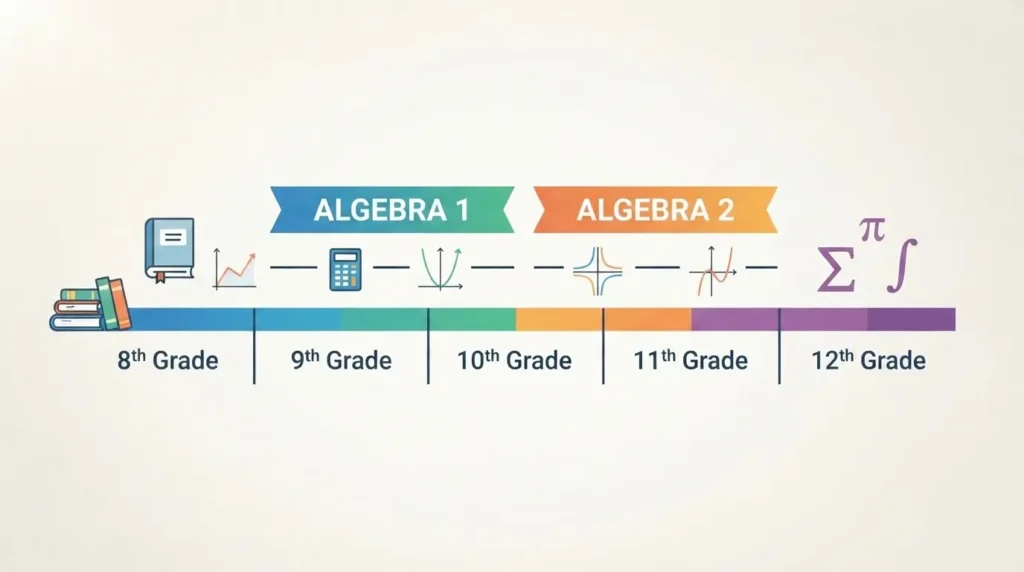
Algebra 1 is most commonly taught in 8th or 9th grade, depending on the student’s math track and school district. Students who are accelerated in math may take Algebra 1 as early as 7th grade, while others encounter it in their freshman year of high school. Algebra 1 introduces foundational mathematical concepts including variables, equations, inequalities, and functions. Mastering Algebra 1 is considered essential because nearly all higher-level math courses build directly on its concepts. Many states require Algebra 1 as a graduation requirement, making it one of the most universally important math courses in the K-12 system.
Algebra 2 is typically taken in 10th or 11th grade, following either Geometry or a combined math sequence. Students who complete Algebra 1 in 8th grade often reach Algebra 2 by 9th or 10th grade. Algebra 2 expands on the concepts introduced in Algebra 1 and introduces more complex topics such as quadratic equations, logarithms, polynomials, and complex numbers. Many colleges require at least Algebra 2 completion for admission, making it a critical course for college-bound students. Students aiming for STEM fields should aim to progress beyond Algebra 2 into Pre-Calculus and Calculus.
| Course | Typical Grade Level | Prerequisite |
|---|---|---|
| Pre-Algebra | 7th Grade | Basic Math |
| Algebra 1 | 8th or 9th Grade | Pre-Algebra |
| Geometry | 9th or 10th Grade | Algebra 1 |
| Algebra 2 | 10th or 11th Grade | Geometry |
| Pre-Calculus | 11th or 12th Grade | Algebra 2 |
| Calculus | 12th Grade | Pre-Calculus |
Grade Level Books — Reading Level Guide by Grade {#books}
Choosing the right books for each grade level is important for building strong reading skills throughout elementary and middle school. Reading level books are categorized using systems like Lexile scores, Guided Reading levels, and grade-level equivalents. Second-grade level books typically feature short chapters, familiar vocabulary, and simple storylines to build reading confidence. Third-grade level books introduce more complex plots, new vocabulary, and longer chapter formats. Both 2nd and 3rd grade level books play a crucial role in helping students transition from learning to read to reading to learn.
Fourth and fifth-grade level books mark a significant jump in complexity, with longer narratives, richer vocabulary, and more nuanced themes. Popular 4th grade level books include titles in the “Magic Tree House” series and “Charlotte’s Web,” which balance engagement with appropriate challenge. Fifth-grade level books like “Hatchet” by Gary Paulsen introduce adventure, survival themes, and chapter lengths that build stamina for middle school reading. Sixth, seventh, and eighth-grade level books continue to push vocabulary, comprehension, and critical thinking. Classic titles like “The Giver,” “The Outsiders,” and “Holes” are common 6th through 8th grade level books that appear in school curricula across the country.
One of the most commonly searched reading level questions is what grade level is Harry Potter. Here is a quick reference:
| Harry Potter Book | Lexile Score | Suggested Grade Level |
|---|---|---|
| The Sorcerer’s Stone | 880L | 4th–5th Grade |
| The Chamber of Secrets | 940L | 5th Grade |
| The Prisoner of Azkaban | 880L | 5th–6th Grade |
| The Goblet of Fire | 880L | 6th Grade |
| The Order of the Phoenix | 950L | 6th–7th Grade |
| The Half-Blood Prince | 1030L | 7th–8th Grade |
| The Deathly Hallows | 1000L | 7th–8th Grade |
DIBELS and STAR Math Scores by Grade Level {#dibels-star}
DIBELS (Dynamic Indicators of Basic Early Literacy Skills) is a standardized assessment used to measure reading fluency and early literacy skills in students from kindergarten through 8th grade. Schools use DIBELS scores by grade level to identify students who may need additional reading support before they fall too far behind. DIBELS measures several key skills including phoneme segmentation, nonsense word fluency, and oral reading fluency. Each grade level has benchmark scores that indicate whether a student is On Track, Below Benchmark, or Well Below Benchmark. Understanding DIBELS scores by grade level helps teachers and parents intervene early and effectively when reading struggles appear.
STAR Math is an adaptive computerized math assessment developed by Renaissance Learning that measures math skills across grade levels from 1st through 12th. STAR Math scores by grade level are reported as a Grade Equivalent (GE) score, a Scaled Score, and a Percentile Rank. A student scoring at grade level will have a GE score that matches their actual grade — for example, a 4th grader scoring 4.0 is performing right on grade level expectations. Scores significantly above or below grade level help teachers make data-driven decisions about instruction and intervention. Both DIBELS and STAR Math are widely used tools that give schools a clear picture of where each student stands relative to their grade-level peers.
Is There a 13th Grade? Everything You Need to Know {#13th-grade}
The question of whether there is a 13th grade has been circulating on social media for years, causing widespread confusion among students, parents, and educators. In the United States, the standard K-12 system ends at 12th grade, and there is no federally mandated 13th grade in the traditional sense. However, some states and school districts have introduced 13th-year programs as a voluntary option for students who want to earn college credit or complete vocational training while still enrolled in high school. These programs — sometimes called Early College High Schools or 5th-year programs — are not the same as a universal 13th grade being added to the American school system. The viral rumors claiming that a 13th grade is being added nationwide are not accurate as of 2026.
Historically, some places have used a 13th grade. Ontario, Canada had a formal Grade 13 from 1921 until it was phased out in 2003. Some countries in Europe and the UK also include a 13th year of secondary education as part of their standard system, which is where much of the international confusion originates. In the US, states like North Carolina have experimented with 13th-grade programs through early college high schools as an equity strategy to boost postsecondary access. These programs allow students to earn an associate’s degree or a significant number of college credits at no cost before formally graduating high school. While the 13th grade concept continues to gain attention from education policymakers, it remains a pilot-level initiative rather than a nationwide requirement.
| Question | Answer |
|---|---|
| Is there a 13th grade in the US? | Not nationwide — only in select states/programs |
| Are they adding a 13th grade? | Some states have pilot programs, but no federal mandate |
| Will there be a 13th grade? | Possibly in some districts; not universally confirmed |
| Did Canada have Grade 13? | Yes — Ontario had Grade 13 from 1921 to 2003 |
| What is 13th grade called? | Early College, Super Senior, or 5th Year Program |

How to Skip a Grade — Is It Possible? {#skip-a-grade}
Yes, it is possible to skip a grade in the United States, but the process is competitive and requires meeting specific academic and developmental criteria. Grade acceleration — the official term for skipping a grade — is most common in elementary and middle school rather than high school. Schools typically require documented evidence of exceptional academic performance, high standardized test scores, and a recommendation from the student’s current teacher. The decision is usually made by a committee that includes school administrators, teachers, parents, and sometimes a school psychologist. Not every district allows grade skipping, so families should check with their school board for the official policy.
Before pursuing grade acceleration, families should carefully consider both the academic and social implications. A student who skips a grade may be academically prepared but find social and emotional challenges in a peer group that is one to two years older. Research shows that when grade skipping is done thoughtfully and with proper support, most students who skip a grade thrive academically and socially. However, rushing the decision without considering the whole child can create unnecessary stress. Working closely with educators, counselors, and the student themselves leads to the best outcome when deciding whether skipping a grade is the right move.
Steps to Skip a Grade:
- Request a formal evaluation from the school principal or counselor
- Gather academic records, test scores, and teacher recommendations
- Complete any required standardized assessments for grade-level placement
- Meet with the school committee or academic review board
- Receive a final decision and develop a transition support plan
What Is a Good Grade in High School? {#good-grade}
A good grade in high school is generally considered to be a B or above, which corresponds to a score of 80% or higher on most grading scales. Most colleges look for a cumulative GPA of at least 3.0 (B average) for general admission, while highly competitive universities often expect a 3.7 or higher. In the US letter grade system, grades typically fall into five categories: A (90–100%), B (80–89%), C (70–79%), D (60–69%), and F (below 60%). Earning consistent B grades or above throughout high school demonstrates academic competency and discipline to college admissions officers. Students who aim for A grades across the board give themselves the strongest possible academic profile for college applications and scholarship competitions.
It is important to remember that a good grade is relative to the difficulty of the course. An A in a standard English class carries less weight than a B in an AP English class because the rigor of advanced coursework is factored into weighted GPA calculations. Most high schools use a weighted GPA scale that gives additional points for honors, AP, and dual-enrollment courses — often making the GPA scale go above 4.0. Maintaining good grades in challenging courses is more impressive to colleges than perfect grades in basic ones. Consistently earning good grades while taking rigorous courses is the winning formula for academic success in high school.
| Letter Grade | Percentage | GPA Value | Status |
|---|---|---|---|
| A+ | 97–100% | 4.0 | Excellent |
| A | 93–96% | 4.0 | Excellent |
| A− | 90–92% | 3.7 | Excellent |
| B+ | 87–89% | 3.3 | Good |
| B | 83–86% | 3.0 | Good |
| B− | 80–82% | 2.7 | Good |
| C+ | 77–79% | 2.3 | Average |
| C | 73–76% | 2.0 | Average |
| D | 60–69% | 1.0 | Below Average |
| F | Below 60% | 0.0 | Failing |
Conclusion
Understanding high school grade level names is one of the most practical pieces of knowledge any student, parent, or educator can have. From freshman through senior year, each grade level comes with its own name, expectations, milestones, and opportunities. Beyond the four core high school grades, this guide has covered the grade school meaning, middle school structure, algebra grade levels, reading-level books, DIBELS and STAR Math benchmarks, the truth about a 13th grade, how to skip a grade, and what counts as a good grade. Whether you are a new student trying to understand where you fit or a parent supporting your child’s education, knowing the complete picture of HS grade level names puts you in control. Use this guide as your go-to reference every time a question about grade levels comes up.
Frequently Asked Questions {#faq}
What are the high school grade level names in order?
The four high school grade level names in order are Freshman (9th grade), Sophomore (10th grade), Junior (11th grade), and Senior (12th grade). These names are used across all four years of American high school and also apply to the four years of college. Students typically enter high school at age 14 and graduate at 18.
What grade is a freshman in high school?
A freshman is a student in 9th grade, the first year of high school. Most freshmen are 14 to 15 years old. The term “freshman” means newcomer and is used to describe first-year students in both high school and college.
What grade is a sophomore?
A sophomore is a 10th-grade student in their second year of high school. Sophomores are typically 15 to 16 years old. The word comes from Greek roots meaning “wise fool” and has been used in academics since the 1650s.
What grade is a junior in high school?
A junior is an 11th-grade student in their third year of high school, typically 16 to 17 years old. Junior year is considered the most academically demanding year, with SAT and ACT testing, college visits, and advanced coursework all taking place during this grade level.
What grade is a senior?
A senior is a 12th-grade student in their final year of high school, usually 17 to 18 years old. Senior year involves college applications, graduation planning, and major milestones like prom and commencement. It is the last year of the American K-12 educational system.
Is there a 13th grade in the US?
There is no universal 13th grade in the United States. Some states and school districts offer voluntary 13th-year programs that allow students to earn college credit while still enrolled in high school, but these are not mandatory additions to the K-12 system. Viral social media claims about a nationwide 13th grade are not accurate as of 2026.
What grade is prom?
Prom is traditionally held for junior (11th grade) and senior (12th grade) students. Most high schools hold a junior prom and a senior prom, with the senior prom being the more significant event. Some schools allow underclassmen to attend as dates of juniors or seniors.
What is a good grade in high school?
A good grade in high school is generally a B or above (80% or higher), which corresponds to a GPA of 3.0 or above. Most colleges look for a 3.0 minimum GPA, while competitive schools prefer 3.7 or higher. Earning good grades in rigorous courses like AP or honors classes is particularly impressive to admissions officers.