
GPA to Letter Grade: Full Conversion Chart & Scale
Understanding your GPA to letter grade conversion is one of the most important academic skills a student can have. Whether you are checking your transcript, applying for college, or tracking your semester progress, knowing where your GPA stands makes everything clearer. Many students receive a numerical GPA on their report card but have no idea what letter grade it represents. This complete GPA to letter grade guide breaks down every GPA value from 2.4 to 3.8 so you always know exactly where you stand. By the end of this article, you will have a complete picture of the 4.0 grading scale and how each number maps to a letter grade.
What Is GPA and Why Does It Matter?
GPA, or Grade Point Average, is the single number that summarizes your academic performance across all courses. Schools, colleges, and employers use this number to quickly assess how well a student is performing overall. It is calculated by assigning a point value to each letter grade and averaging those values across all courses, weighted by credit hours. A higher GPA generally signals stronger academic achievement and opens doors to scholarships, honors programs, and competitive graduate school applications. Understanding your GPA to Letter Grade is not just about a number — it is about knowing where you stand academically and what your next move should be.
How GPA to Letter Grade Conversion Works
Standard 4.0 GPA Scale Explained
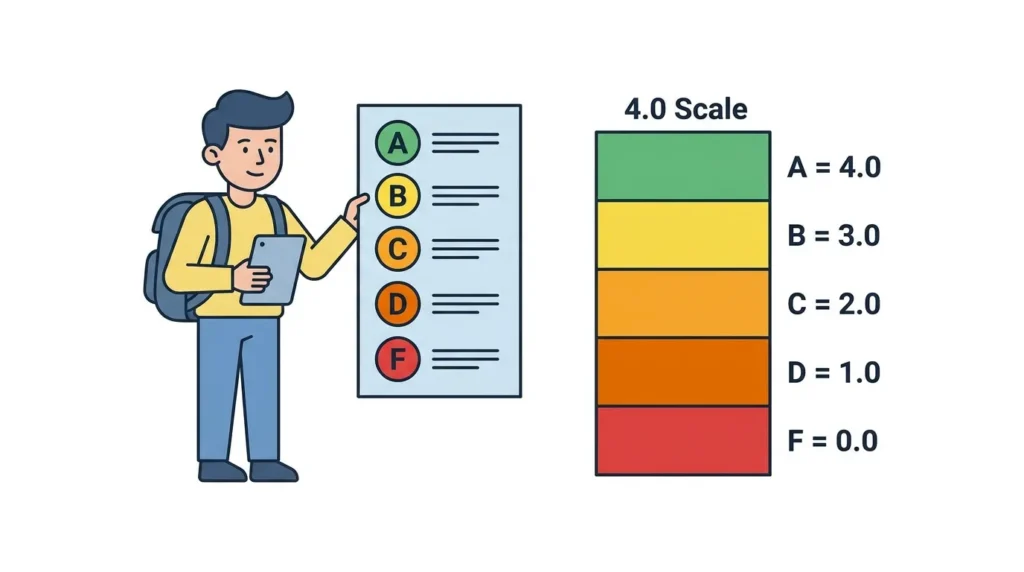
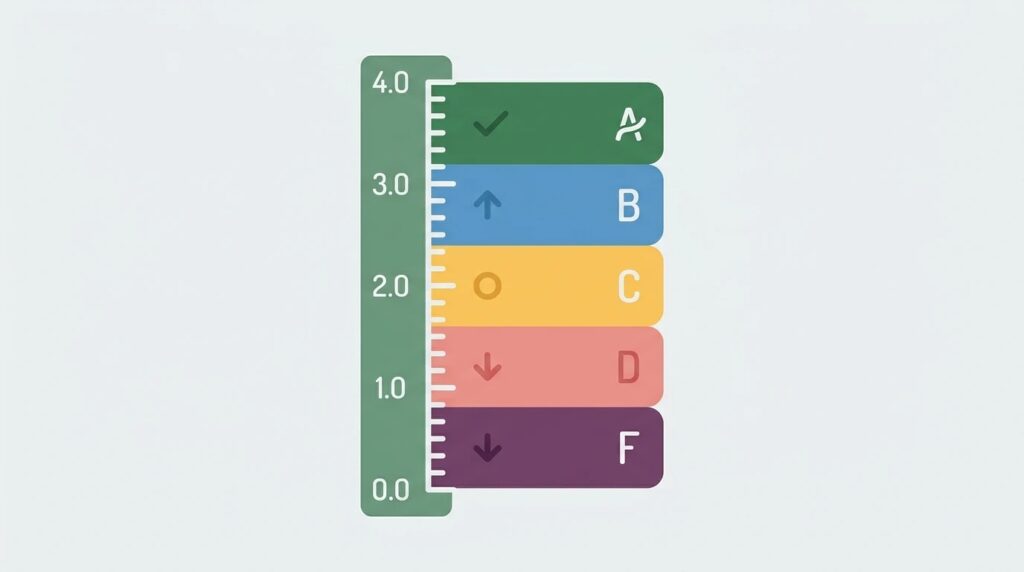
The standard 4.0 GPA scale is the most widely used GPA to Letter Grade conversion system across American high schools and colleges. In this system, an A equals 4.0, a B equals 3.0, a C equals 2.0, and a D equals 1.0, with an F earning 0.0. Most schools also use plus and minus grades that fall between these whole numbers, such as A- (3.7) or B+ (3.3). To find your GPA, you multiply each course grade point by the number of credit hours, add them all together, and divide by the total credit hours. This gives you a weighted average that reflects both your grades and the difficulty of each course load.
Weighted vs Unweighted GPA Scale
An unweighted GPA is calculated the same way for every course, whether it is a standard class or an advanced one. A weighted GPA, on the other hand, gives extra points to honors, AP, or IB courses — sometimes going up to 5.0. If you earned an A in an AP class on a weighted scale, that A could translate to 5.0 rather than the standard 4.0. Most colleges recalculate GPAs on their own unweighted 4.0 scale when reviewing applications to keep comparisons fair. Knowing which scale your school uses is essential before understanding your GPA to Letter Grade conversion accurately.
Complete GPA to Letter Grade Conversion Chart
This table covers the full standard 4.0 scale used by most US high schools and colleges.
| GPA Range | Letter Grade | Percentage Range | Academic Standing |
|---|---|---|---|
| 4.0 | A+ / A | 97–100% | Exceptional |
| 3.7 – 3.99 | A- | 90–96% | Excellent |
| 3.3 – 3.69 | B+ | 87–89% | Very Good |
| 3.0 – 3.32 | B | 83–86% | Good |
| 2.7 – 2.99 | B- | 80–82% | Above Average |
| 2.3 – 2.69 | C+ | 77–79% | Slightly Above Average |
| 2.0 – 2.29 | C | 73–76% | Average |
| 1.7 – 1.99 | C- | 70–72% | Below Average |
| 1.3 – 1.69 | D+ | 67–69% | Poor |
| 1.0 – 1.29 | D | 65–66% | Very Poor |
| 0.0 | F | Below 65% | Failing |
Quick Tip: If your GPA falls between two ranges in this table, use the lower range’s letter grade. Always double-check with your institution’s official grading policy, as cutoffs can vary slightly.
Understanding Your GPA — What Does It Mean?
2.4 GPA Letter Grade — Is It Good or Bad?
A 2.4 GPA to Letter Grade conversion gives you a C+ on the standard 4.0 scale. This places you slightly above average, but it is below the 2.5 threshold that many colleges and scholarship programs require for eligibility. If you are a high school student, a 2.4 GPA may limit your college options somewhat, particularly at more selective institutions. However, it is absolutely not the end of the road — many community colleges and universities accept students with this GPA. The key is to focus on bringing it up before your final transcripts are sent.
2.5 GPA Letter Grade & What Is a 2.5 GPA in Letter Grade
A 2.5 GPA is a C+ letter grade, sitting right at the midpoint of the above-average range. Many college programs and financial aid offices use 2.5 as their minimum GPA cutoff, so reaching or maintaining this level is often critical. If someone asks what is a 2.5 GPA to Letter Grade equivalent — the straightforward answer is C+, equivalent to roughly 77–79% in most grading systems. This GPA shows you are passing your courses but still have meaningful room for improvement. Setting a goal to reach 2.7 or above can significantly expand your academic and professional opportunities.
2.6 GPA Letter Grade
A 2.6 GPA to Letter Grade result also falls in the C+ range, just slightly above the 2.5 mark. It represents a student who is performing consistently above average without yet reaching B-level performance. Many athletic eligibility requirements and student organization memberships require at least a 2.5, so a 2.6 clears that bar comfortably. One or two strong semesters can push a 2.6 GPA toward B- territory relatively quickly. Keep prioritizing your core courses to make the biggest impact on your cumulative average.
2.7 GPA Letter Grade
A 2.7 GPA to Letter Grade conversion corresponds to a B– on the 4.0 scale. This is an important milestone because it officially moves you from C-range into B-range academic performance. Many graduate school programs and competitive internships list 2.7 or 3.0 as their minimum GPA for applicants. Employers in fields like finance, law, and engineering sometimes screen resumes by GPA, and crossing the 2.7 threshold can make a real difference. If you are at 2.7, you are close enough to 3.0 that a focused semester can get you there.
2.8 GPA Letter Grade
A 2.8 GPA to Letter Grade conversion translates to a B-, placing you solidly in above-average academic territory. At this level, most standard university programs will consider you in good academic standing. A 2.8 GPA is often sufficient for many professional programs, though competitive ones like law or medicine will expect significantly higher. The good news is that the gap between 2.8 and 3.0 is narrow, and it can often be closed with strong performance in just one or two terms. Focusing on your hardest courses first will yield the biggest GPA to Letter Grade improvement fastest.
2.9 GPA Letter Grade
A 2.9 GPA to Letter Grade result is also a B–, placing you just one tenth of a point away from the psychologically and practically significant 3.0 mark. Many students at 2.9 feel frustrated because they are so close to a B average yet still fall short. This is the ideal GPA range to buckle down with a strategic study plan for the next semester. A single strong semester — particularly in high-credit courses — can push you past 3.0.Think of your 2.9 GPA to Letter Grade standing not as a disappointment but as a launching pad.

B Range GPA — Are You on Track?
3.1 GPA Letter Grade
A 3.1 GPA to Letter Grade conversion gives you a B, representing solid, consistent academic performance. Students at this level are generally considered in good academic standing at most colleges and universities. A 3.1 is often sufficient to qualify for many scholarships, honors recognition, and graduate program minimum requirements. This GPA signals that you understand your coursework and are putting in reliable effort across your classes. If 3.5 or higher is your target, a 3.1 GPA to Letter Grade result means you are on the right path and just need to push a bit harder.
3.2 GPA Letter Grade
A 3.2 GPA to Letter Grade result is a B, showing above-average academic achievement. At this level, you are likely eligible for a wide range of academic scholarships and are a competitive applicant for many graduate programs. A 3.2 GPA is respected by most employers and professional schools as a demonstration of consistent hard work. Students with a 3.2 are often strong candidates for leadership positions in student organizations that require minimum GPA thresholds. Continuing at this pace while challenging yourself with harder courses will make your GPA to Letter Grade standing even more impressive.
What Is a 3.3 GPA in Letter Grade?
A 3.3 GPA to Letter Grade conversion to a B+ letter grade on the 4.0 scale. When students ask what is a 3.3 GPA in letter grade, the answer places them in very good academic standing. A B+ indicates you are performing better than the average student and approaching A-range academic work. This GPA is competitive for many selective graduate programs and puts you in contention for merit-based financial aid. If you are aiming for medical, law, or business school, using a 3.3 as a foundation and building upward is a smart GPA to Letter Grade strategy.
3.4 GPA Letter Grade
A 3.4 GPA to Letter Grade result is a B+, placing you firmly in the upper tier of B-range performance. Many highly ranked universities consider 3.4 and above as the competitive range for graduate school admissions. This GPA also qualifies students for many prestigious honors programs and departmental recognition awards. A 3.4 is close enough to 3.5 — the common threshold for high honors or Latin honors designations — that one strong semester can make the difference. Stay consistent and strategic about your GPA to Letter Grade growth to maximize your academic opportunities.
High GPA — You’re Doing Great!
3.5 GPA Letter Grade & What Is a 3.5 GPA in Letter Grade
A 3.5 GPA to Letter Grade conversion gives you a B+ to A- letter grade depending on the institution’s specific scale. When people ask what is a 3.5 GPA in letter grade, most schools place it right at the boundary between B+ and A-. This is an academically significant level because 3.5 is the most common threshold for Dean’s List recognition and Latin Honors (Cum Laude) eligibility. A 3.5 GPA to Letter Grade result is highly competitive for graduate school applications, scholarship awards, and professional program admissions. If you have reached 3.5, you are clearly doing excellent academic work — the goal now is to maintain or exceed it.
3.6 GPA Letter Grade
A 3.6 GPA to Letter Grade conversion gives you an A–, placing you in excellent academic territory. At this level, you are outperforming the majority of your peers and demonstrating a strong, consistent command of your coursework. A 3.6 is competitive for even selective graduate programs like law, medicine, and MBA programs at many universities. Most honors designations, departmental awards, and prestigious scholarships are well within reach at this GPA to Letter Grade level. A 3.6 is something to be genuinely proud of — keep up the excellent work.
What Is a 3.7 GPA in Letter Grade?
A 3.7 GPA to Letter Grade result is an A- letter grade on the standard 4.0 scale. When students ask what is a 3.7 GPA in letter grade, the answer is clearly in the A-range — a strong academic achievement by any measure. A 3.7 is competitive for top graduate programs, including medical school and law school, where average GPA to Letter Grade benchmarks often fall between 3.5 and 3.9. It demonstrates that a student is mastering their coursework with only occasional slips from perfect performance. A 3.7 GPA is an outstanding academic achievement that reflects dedication, discipline, and intellectual ability.
3.75 GPA Letter Grade
A 3.75 GPA to Letter Grade conversion sits at the upper end of the A- range, very close to the full A level. This GPA is considered exceptional and is often associated with Magna Cum Laude or similar honors designations at graduation. Students with a 3.75 are typically among the top academic performers in their class or department. This GPA to Letter Grade level opens doors to highly competitive fellowships, research programs, and graduate school opportunities. At 3.75, you are operating near the ceiling of academic achievement — a few more strong semesters can push you to 3.8 or beyond.
3.8 GPA Letter Grade & What Is a 3.8 GPA in Letter Grade?
A 3.8 GPA to Letter Grade conversion gives you a solid A-, placing you at the very top of academic performance. When students ask what is a 3.8 GPA in letter grade, the answer is A- — just 0.2 points away from a perfect 4.0. This GPA to Letter Grade result is competitive for the most selective graduate and professional programs in the country. Many full-tuition scholarship programs, medical school honors tracks, and prestigious fellowships list 3.8 or above as their preferred GPA minimum. A 3.8 GPA is something that employers, admissions committees, and academic departments all recognize as truly outstanding.
How to Improve Your GPA
Improving your GPA to Letter Grade result takes consistent effort, smart strategy, and a clear understanding of how your grades are weighted. Here are the most effective and practical steps:
- Prioritize high-credit courses — Grades in 4-credit courses affect your GPA more than 1-credit courses. Focus your best effort where it counts most.
- Retake courses strategically — Many schools allow grade replacement for repeated courses. Check your school’s policy and retake any course where you earned a C or below.
- Use office hours and tutoring — Professors and academic support centers exist specifically to help students improve. Using them consistently makes a measurable difference.
- Track your GPA every semester — Use GPA calculator after receiving each grade. Knowing where you stand helps you make smarter decisions about future course loads.
- Balance your schedule — Taking too many hard courses in one semester can drag your GPA down. Spread challenging courses across multiple terms for better performance.
- Eliminate distractions during study time — Research consistently shows that focused, distraction-free study produces better retention and exam scores directly improving your GPA to Letter Grade results over time.
- Plan for finals early — A strong final exam performance can move a B- to a B or a B to an A in many courses, producing meaningful GPA gains at the end of each term.
Conclusion
Converting your GPA to Letter Grade is simple once you understand the 4.0 scale. Every GPA value from 2.4 to 3.8 maps to a specific letter grade that tells a clear story about your academic performance. Whether you are at 2.5 working toward that first B, or at 3.8 chasing a perfect 4.0, understanding your GPA to Letter Grade position on the scale helps you set realistic and motivating goals. Use the charts and breakdowns in this guide as your go-to reference throughout your academic career. Your GPA is not just a number — it is a reflection of your effort, your growth, and your potential.
Frequently Asked Questions
Q1: What letter grade is a 2.5 GPA? A 2.5 GPA is equivalent to a C+ letter grade on the standard 4.0 scale. It typically corresponds to a percentage range of 77–79% and is considered slightly above average academic performance.
Q2: What is a 3.5 GPA in letter grade? A 3.5 GPA falls between B+ and A- depending on the institution. It is commonly recognized as the threshold for Dean’s List and Cum Laude honors, representing excellent academic achievement.
Q3: Is a 3.0 GPA a B grade? Yes, a 3.0 GPA is exactly a B letter grade on the standard 4.0 scale. It represents good academic standing and is the minimum GPA required by many graduate programs.
Q4: What is a 3.7 GPA in letter grade? A 3.7 GPA is an A- letter grade. It represents exceptional academic performance and is competitive for selective graduate and professional school applications.
Q5: Is a 2.7 GPA good enough for graduate school? A 2.7 GPA meets the minimum requirement for some graduate programs, but most competitive programs prefer a 3.0 or higher. It depends heavily on the field and the specific program’s admissions criteria.
Q6: What is a 3.8 GPA equivalent to in letter grade? A 3.8 GPA is an A- letter grade, placing a student near the top of the academic scale. It is highly competitive for scholarships, honors, and selective program admissions.
Q7: Does GPA include plus and minus grades? Yes, on the standard 4.0 scale, plus and minus grades are included. For example, a B+ is 3.3, a B is 3.0, and a B- is 2.7, allowing for more precise grade point calculation.
Q8: What GPA is needed for Cum Laude? Most universities require a minimum GPA of 3.5 for Cum Laude, 3.7 for Magna Cum Laude, and 3.9 or above for Summa Cum Laude, though exact cutoffs vary by institution.